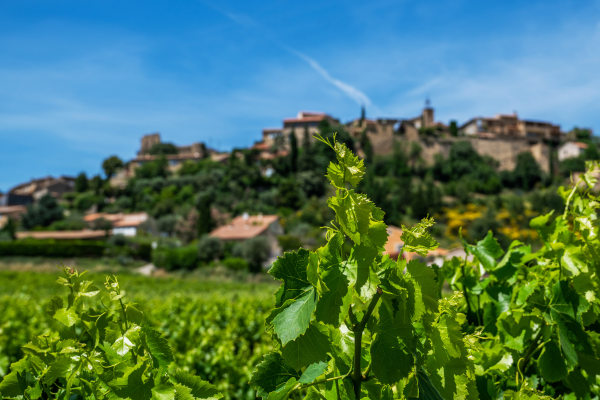
Few wine regions in the world feel as divided and yet deeply connected as the Rhône Valley. Stretching from the granite slopes in the North to the sun-soaked South, the Rhône tells two distinct very stories. They differ in landscape, climate, grapes, and culture. And yet, they form one of France’s most compelling and complete expressions of place.
Southern Rhône: Sun, Stone, and the Art of the Blend
The Southern Rhône is expansive and warm. In the South, the landscape’s rolling hills, relentless winds and hot and dry summers create wines with a rugged identity. Soils range from sandy plains to the famous galets roulés, the large stones that absorb the heat that keeps the vines warm during the cool nights .
Historically, the South has been a land of blending. While wine has been made here since the Romans, the region’s modern identity has been solidified around the complex blends. The pinnacle of this philosophy is Châteauneuf du Pape, where up to thirteen grape varieties are permitted. Grenache is the beating heart of the region, supported by Syrah, Mourvèdre, and others that add spice and structure.
Other appellations like Gigondas, and Côtes du Rhône Villages offer expressions that range from powerful to vibrant. Producers like Château de Beaucastel, Domaine du Vieux Télégraphe, and more have proved that Southern Rhône wines can rival the world’s great bottles.
Culturally, the Southern Rhône feels communal. The region’s wines were historically crafted for the table, meant to accompany food and conversation rather than dominate it. Even at their most structured, these wines carry warmth and approachability. Ripe red fruit, garrigue herbs, peppery spice, and sun-baked earth are signatures of the style.
The Southern Rhône demonstrates the power of harmony. Its wines are about balance, and the way different elements come together to create something greater than their parts.
Northern Rhône: Granite, Precision, and Singular Voice
Travel North and the Rhône narrows, both geographically and stylistically. The vineyards cling to steep, terraced slopes carved into granite hillsides. The climate shifts, with colder winters, and the wind still blows, but its a bit more bracing.
If the south is the land of blending, the North is the land of singularity. Red wines are almost exclusively made from Syrah. White wines are centered on Viognier. The result is a region defined by focus and precision.
Côte-Rôtie offers perfumed, finely etched Syrah, sometimes co-fermented with a touch of Viognier for aromatic lift. Hermitage stands as the north’s monument, producing powerful, age-worthy wines of depth and structure. Cornas delivers darker, more brooding expressions, while Saint-Joseph stretches along the river with varied but often beautifully structured styles.
Historic names such as E. Guigal, Jean-Louis Chave, and Auguste Clape have shaped the global reputation of the Northern Rhône. Many vineyards remain labor-intensive, with hand-harvesting that demands devotion.
Culturally, the Northern Rhône feels more intimate and traditional, and it demands attention to detail… and the wines reflect that intensity. They are often savory and mineral-driven, with black olive, smoked meats, and cracked pepper notes defining their profile.
The Northern Rhône shows what happens when one grape meets one place with almost uncompromising focus. These are wines of identity, shaped by slope and stone.
One River, Shared Roots
Despite their contrasts, both regions share essential foundations. The Rhône River is their lifeline, moderating climate and historically serving as a trade route that carried these wines far beyond France. Both prize tradition, whether expressed through blending or single-varietal purity. And both have long histories dating back to Roman viticulture, with monasteries and farming families preserving knowledge across centuries.
Above all, both regions believe in expressing a sense of place. Whether through the warm complexity of Grenache blends or the steel cut precision of Syrah, the goal remains the same: wine must speak of where it comes from.
Differences That Unite
Together, these regions form a study in contrast that deepens appreciation for both. When experienced side by side, they reveal the full spectrum of what the Rhône Valley can achieve.
The Rhône Wars are not a rivalry to be settled. They are a dialogue between two expressions of the same river.
In the end, it is not about choosing sides. It is about understanding how sun and granite, blend and singularity, all belong to one enduring story.
Leave a Reply