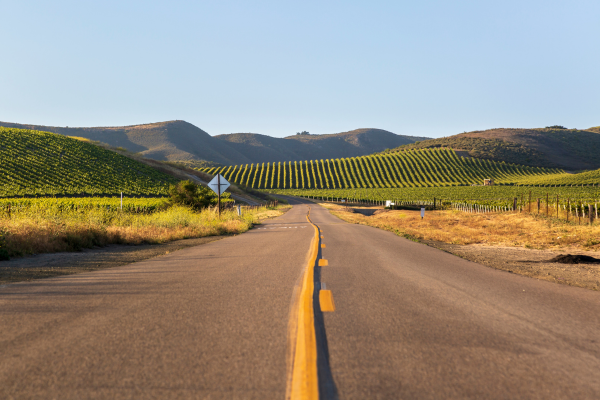
California’s Central Coast
Our first stop on the West Coast 101 road trip takes us to one of California’s most dynamic and diverse wine regions: the Central Coast.
Stretching roughly 250 miles from Monterey County in the north to Santa Barbara County in the south, the Central Coast is a place where rugged coastlines, rolling hills, and vineyard-covered valleys create some of the most compelling wines in the world.
Like any great road trip destination, the Central Coast rewards curiosity. Every turn reveals a different landscape, which welcomes in a different expression of California wine.
It’s a region defined by contrast. Cool ocean fog drifts through coastal vineyards just miles from sun-soaked hillsides. Limestone-rich soils nurture powerful reds in Paso Robles, while windy vineyards in Santa Barbara produce elegant Pinot Noir and Chardonnay that rival some of the world’s finest examples.
But before the region became a destination for wine lovers, it was shaping California’s wine story long before most people realized it.
A History Rooted in Exploration
The story of Central Coast wine begins more than two centuries ago.
In the late 1700s, Spanish missionaries established a chain of missions along California’s coast. Among their many agricultural pursuits was the planting of grapevines, primarily for sacramental wine. Vineyards appeared near missions throughout the region, including what are now Monterey, San Luis Obispo, and Santa Barbara Counties.
For much of the nineteenth and early twentieth centuries, however, the Central Coast remained overshadowed by California’s more established wine regions. Farming dominated the landscape, and many of the area’s vineyards supplied fruit for bulk wine production rather than fine wine.
Everything began to change in the 1960s and 1970s.
A new generation of pioneering growers recognized something remarkable about the Central Coast. The same Pacific Ocean that drew travelers to California’s coastline created ideal growing conditions for wine grapes. Cool marine air, long growing seasons, and diverse soils offered opportunities unlike anywhere else in the state.
Visionary producers began planting vineyards in places many considered too cold, too remote, or too risky. Their gamble paid off.
Over the following decades, regions such as Santa Barbara County, Monterey County, and Paso Robles developed distinct identities, helping establish the Central Coast as one of the most exciting wine-growing areas in the world.
The Influence of the Pacific
Unlike many wine regions, where mountain ranges run north to south, parts of California’s Central Coast feature valleys that open directly to the Pacific Ocean. These corridors allow cool marine air and fog to travel inland, moderating temperatures and extending the growing season.
In cooler areas, Chardonnay and Pinot Noir thrive, developing bright fruit with remarkable elegance. In warmer inland regions, Rhône varieties, Cabernet Sauvignon, and Zinfandel produce wines with richness, depth, and high concentration.
Few wine regions can offer such dramatically different styles within a single destination.
Paso Robles: California’s Rhône and Cabernet Powerhouse
If the Central Coast has a frontier spirit, Paso Robles may be its greatest expression.
Once known primarily for cattle ranches and agriculture, Paso Robles has transformed into one of California’s most respected wine regions. Its combination of warm days, cool nights, and distinctive limestone-rich soils allows a wide range of grape varieties to flourish.
The region has become especially celebrated for Rhône-inspired wines, including Syrah, Grenache, and Mourvèdre, as well as increasingly impressive Cabernet Sauvignon.
Paso Robles also helped foster a culture of experimentation. Producers here have long embraced innovation, blending varieties and exploring vineyard sites that challenge conventional wisdom.
That adventurous spirit remains one of the region’s defining characteristics today.
Santa Barbara County: Where Cool Climate Wines Shine
Travel south and the landscape changes dramatically.
Santa Barbara County’s unique east-west valleys funnel cool Pacific winds deep inland, creating one of California’s most distinctive growing environments.
These conditions make the region particularly well-suited to Pinot Noir and Chardonnay. The wines often balance California sunshine with freshness and precision, producing bottles that are both expressive and age-worthy.
The area gained international attention through films, critics, and collectors, but its reputation ultimately rests on the quality of its vineyards and the dedication of its growers.
Today, Santa Barbara stands among the world’s premier destinations for cool-climate wine.
Monterey County: The Quiet Pioneer
While Paso Robles and Santa Barbara often capture headlines, Monterey County has played a crucial role in the Central Coast’s success story.
The cooling influence of Monterey Bay creates one of California’s longest growing seasons, allowing grapes to ripen slowly while retaining vibrant acidity.
The region has earned particular acclaim for Chardonnay, Pinot Noir, and Sauvignon Blanc, producing wines that combine freshness, complexity, and balance.
Many of California’s most respected vineyard sites can be found here, even if they don’t always receive the same attention as their southern neighbors.
The Producers Who Shaped the Region
No discussion of the Central Coast would be complete without recognizing the winemakers who helped define its identity.
Producers such as Sine Qua Non, Paul Lato, and Carlisle have pushed boundaries, challenged expectations, and demonstrated the extraordinary potential of Central Coast vineyards.
Their success helped attract attention to the region and paved the way for a new generation of winemakers who continue to elevate its reputation.
Today, the Central Coast is home to countless producers crafting wines that range from iconic collector bottles to hidden gems waiting to be discovered.
Why the Central Coast Matters
What makes the Central Coast so compelling is not any single grape, winery, or appellation, but rather, its diversity.
Few regions can offer the range of styles found here. Within a day’s drive, you can experience world-class Chardonnay, Pinot Noir, Rhône blends, Cabernet Sauvignon, and countless expressions in between.
It is a region where innovation thrives, where old assumptions are constantly challenged, and where some of California’s most exciting wines continue to emerge.
For wine lovers, it represents one of the most rewarding destinations on the West Coast.
And for our road trip, it is the perfect place to begin.
Next stop: another iconic region along the Pacific Coast, where a new chapter of West Coast wine history awaits.
Leave a Reply