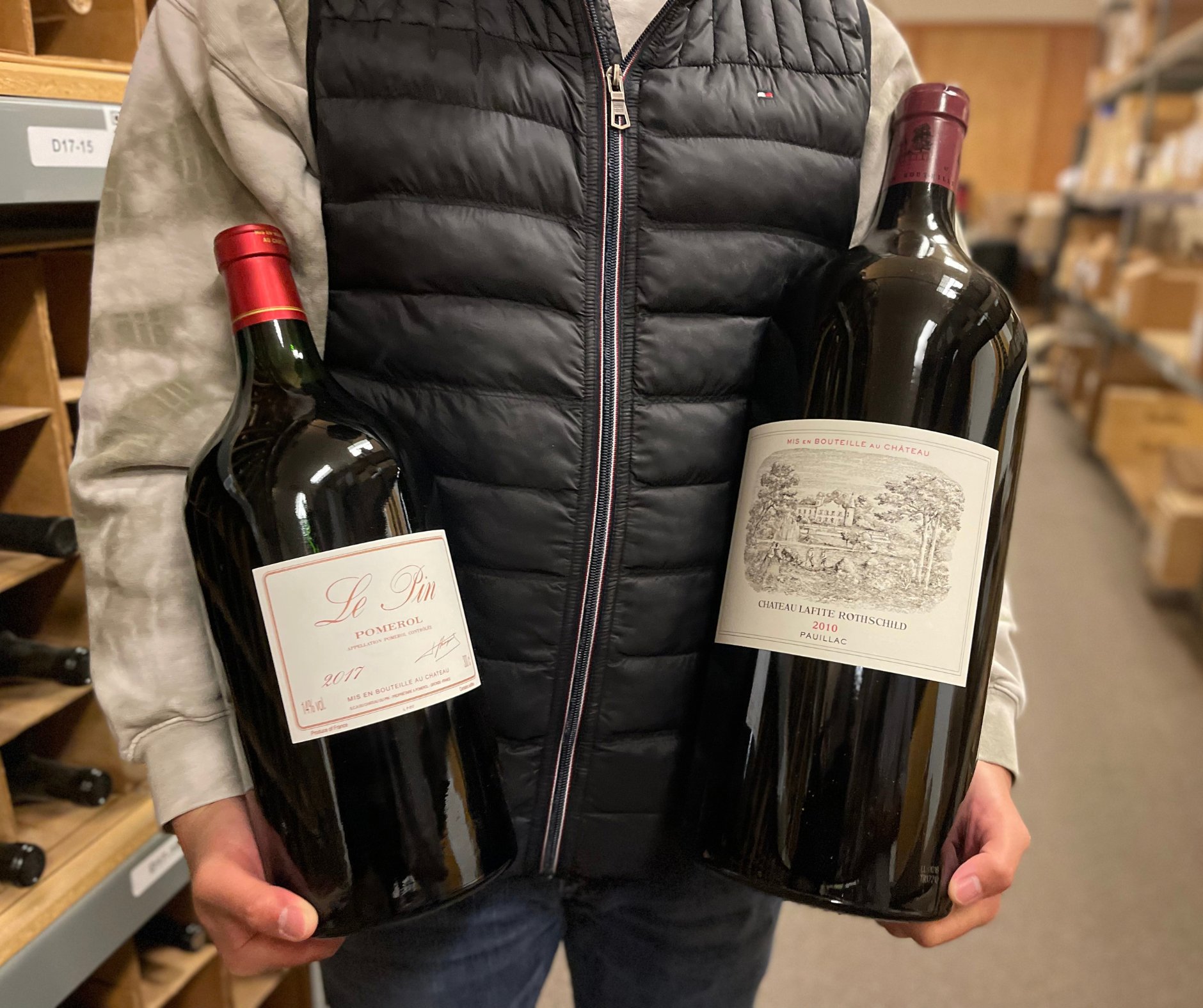
Wine Bottle Size Chart and Guide to Every Format
Wine bottle sizes can tell you more than how much wine is inside. A half bottle can make an older vintage easier to open on a quiet evening. A magnum gives a gathering one wine to share. At the far end of the scale, an 18 liter bottle holds the equivalent of 24 standard bottles.
The names can be less straightforward than the numbers, especially when Champagne enters the conversation. Here is a guide to the sizes, what they are called, and when each format makes sense.
Wine bottle sizes at a glance
A standard wine bottle holds 750 mL. Every equivalent below is measured against that size.
| Bottle size | Common name | Equivalent to |
|---|---|---|
| 375 mL | Half bottle | ½ standard bottle |
| 750 mL | Standard bottle | 1 bottle |
| 1.5 L | Magnum | 2 bottles |
| 3 L | Double magnum for still wine; Jeroboam for Champagne | 4 bottles |
| 4.5 L | Jeroboam for still wine; Rehoboam for Champagne | 6 bottles |
| 6 L | Imperial for still wine; Methuselah for Champagne | 8 bottles |
| 9 L | Salmanazar | 12 bottles |
| 12 L | Balthazar | 16 bottles |
| 15 L | Nebuchadnezzar | 20 bottles |
| 18 L | Solomon in Champagne | 24 bottles |
Half bottles: A smaller commitment
At 375 mL, a half bottle contains exactly half the wine of a standard bottle. It is useful when one person wants a particular wine, when a couple wants to try two wines with dinner, or when dessert calls for a few glasses of something special.
For collectors, half bottles offer another way to experience a favorite producer or vintage. They can develop more quickly than larger formats, so the size is worth considering when choosing an older wine. Explore Benchmark Wine Group’s half bottles for wines that suit a smaller occasion.
Magnums: The collector’s favorite large format
A 1.5 L magnum holds the equivalent of two standard bottles. It is generous enough for a group, yet still practical to store, open, and pour.
Magnums also interest collectors for what happens before opening. Wine in a magnum generally develops more slowly than the same wine in a standard bottle. That can make the format appealing for a wine intended to spend years in the cellar. Bottle size is only part of the story, though. Vintage, storage, and bottle condition still matter.
At the table, a magnum has a simpler advantage: everyone gets to share the same bottle.
Double magnums and beyond: When the occasion grows
A 3 L double magnum holds four standard bottles. From there, each step becomes a bigger event. A 6 L bottle holds eight; a 9 L Salmanazar holds twelve. By the time you reach an 18 L Solomon, you are pouring the equivalent of 24 standard bottles from one Champagne bottle.
These formats can make a remarkable centerpiece for a milestone celebration. They also need more planning. Think about cellar space, how the bottle will be moved, and who will help pour it before choosing one for an event.
Curious to see these formats in the cellar? Explore the new large format arrivals, from magnums to bottles made for a larger celebration.
Why is a Jeroboam sometimes 3 L and sometimes 4.5 L?
This is the question that catches even experienced wine buyers. In Champagne, a Jeroboam is 3 L. For still wine, the 3 L format is generally called a double magnum, while a Jeroboam is 4.5 L.
The names differ again at 6 L: Imperial for still wine and Methuselah for Champagne. When a listing uses a traditional name, check the volume as well. The number of liters tells you exactly what you are buying.
Which wine bottle size should you choose?
Start with what you want the bottle to do. A half bottle is suited to a smaller pour or a chance to explore. A standard bottle works for most dinners. A magnum offers both cellar appeal and enough wine to share. Larger formats make the most sense when the occasion, the guest list, and the space to serve them all line up.
Whatever the format, the right bottle is the one you will be glad to open. Explore wines beyond the standard 750 mL bottle at Benchmark Wine Group.
Cheers,
The BWG team
Leave a Reply